
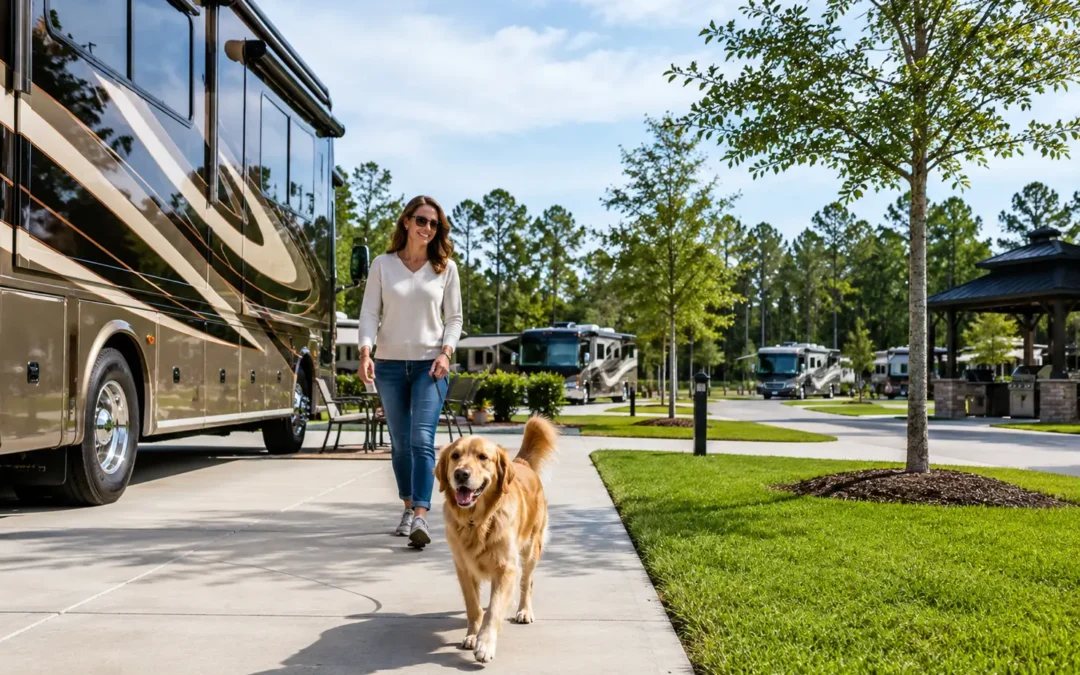
If you travel with a dog, you already know the drill. You call ahead. You ask about breed restrictions. Then you wonder whether “pet friendly” really means a fenced yard and clean walking paths, or just a sign at the front office that tolerates pets without planning for them. Not every pet friendly RV park near Houston delivers on that label. The gap between the two shows up fast, usually right after you’ve unhitched and your dog is already pulling toward the nearest patch of grass.
This guide breaks down what a genuinely pet friendly RV park near Houston should offer. It covers the specific questions worth asking before you book. It also explains how to tell a resort that merely tolerates dogs apart from one that’s actually built around them. Much of this applies just as well to any pet friendly RV park in Texas, not only resorts near the Houston metro.
What “Pet Friendly” Actually Means at an RV Park
RV parks use the phrase “pet friendly” loosely. At the low end, it simply means the park doesn’t ban dogs outright. At the higher end, a true dog friendly RV resort near Houston builds pets into the design of the place. Fenced dog parks, waste stations spaced around the property, and wide walking paths all signal real planning, not just tolerance. So does staff who know the pet policy well enough to explain it clearly on the spot.
Before booking, separate “allowed” from “planned for.” A resort that genuinely plans for pets usually offers the following:
- A dedicated, fenced off-leash area, not just open grass near the entrance
- Waste stations placed throughout the property, not only near the office
- Shaded walking routes, since Houston’s summer pavement gets brutal fast on paws
- Clear signage about leash rules and quiet hours around pet areas
- A published pet policy you can read before you call, rather than one you have to ask for
- Staff who can answer pet-related questions on the spot instead of transferring you to a manager
This distinction matters more than it sounds. A resort that treats pets as an afterthought will often give vague or inconsistent answers when you ask specific questions. A resort built around pet travelers tends to have those answers ready. Staff hear the same questions constantly, and the property has built real infrastructure to match.
Fencing and Off-Leash Space
A fenced dog park is the single biggest difference between an RV park that tolerates pets and one built for them. Off-leash time matters for dogs cooped up during travel days. A properly fenced area lets your dog burn off pent-up energy without you white-knuckling a leash near a busy access road.
When comparing options, ask three things directly. Does the resort fence the dog park on all sides? Is the space separated by size, for small breeds and large breeds? And is there any shade during the hottest parts of the day? These details rarely make it into a listing photo. A direct question before you commit is worth the two minutes it takes.
Size matters too. A cramped, quarter-acre pen labeled a “dog park” gives a very different experience than a full acre where a dog can actually run. Photos online can be misleading. A quick phone call almost always gets you a more honest answer than a listing description does.
Walking Paths and Site Spacing
Wide, well-maintained walking paths matter more than most travelers expect. That is, until they’re navigating one with a leash in one hand and a coffee in the other. Paths that loop through the property, rather than dead-ending at a fence line, give dogs and owners more of an actual walk. It beats a repetitive lap around the same fifty feet of pavement.
Site spacing plays into this too. Closer-packed RV parks tend to produce more territorial barking between neighboring dogs. This shows up most during check-in and check-out windows, when new scents and new arrivals appear throughout the day. A resort with generous spacing between sites tends to run quieter for everyone, pets included. It also gives your own dog more room to settle in without feeling boxed in by unfamiliar neighbors on every side.
Traveling with a dog that reacts to other animals? Ask whether the resort offers corner sites or sites near the edge of the property. That extra separation can make a real difference for an anxious or vocal dog.
Breed and Weight Restrictions
This is where a lot of pet friendly claims fall apart. Some RV parks near Houston cap weight at 25 or 50 pounds. Others maintain breed restriction lists that can rule out otherwise well-behaved dogs, regardless of temperament. Neither policy is unreasonable on its own. Insurance requirements often drive these rules more than any judgment about a particular dog. Still, it’s exactly the kind of detail you should confirm early. Nobody wants to find out three hours into a drive, with the dog already in the back seat.
Ask directly whether the resort restricts breeds. Ask whether a weight limit applies per pet or per household, and how many pets each site allows. Own a breed that commonly shows up on restriction lists? Mention it upfront when you call, rather than waiting until check-in. A resort that’s honest about its policy will tell you clearly, which saves everyone a difficult conversation later.
This holds true whether you’re searching specifically near Houston or looking more broadly for a pet friendly RV park in Texas. Policies differ enough from resort to resort that assuming one park’s rules apply to another can lead to an unpleasant surprise at arrival.
Vet Access and Emergency Planning
Even the best-planned trip can turn into an unplanned vet visit. Before booking a pet friendly RV park near Houston, find out how far the nearest emergency vet clinic actually is. Five minutes away is a very different situation than forty minutes away. That gap matters even more late at night or during a holiday weekend, when regular clinics may be closed.
Front desk staff at a well-run resort should answer this question without hesitation. They’ve likely fielded it before. A resort that can’t tell you where the nearest emergency vet is has probably not thought much about pet travelers beyond the “dogs allowed” sign at the entrance.
Preparing Your Dog for RV Travel
A little preparation beyond choosing the right resort goes a long way toward a smoother trip.
Before You Leave
Dogs that haven’t spent much time in a moving RV can find the motion, engine noise, and unfamiliar smells stressful at first. Take a short local drive before a longer trip to see how your dog handles it. That test run also gives you a chance to adjust with a crate, a seatbelt harness, or calming aids if needed.
After You Arrive
Keep your dog on a leash near the RV for the first walk or two. That gives them time to adjust to new smells and sounds without feeling overwhelmed. Bring familiar bedding and toys, since familiar scents help dogs settle into an unfamiliar site faster. Pack more water than you think you’ll need. Between the Texas heat and the extra walking that comes with RV travel, dogs dehydrate faster than owners often expect.
Questions Worth Asking Before You Book
Run through this list on the phone or in a booking chat before reserving a site at any pet friendly RV park near Houston or elsewhere in Texas:
- Is the dog park fenced, and is it separated by size?
- Are there breed or weight restrictions, and how are they enforced?
- How many pets can stay per site?
- Does the property place waste stations throughout, or only near the entrance?
- How far away is the nearest emergency vet clinic?
- Are there quiet hours or leash rules specific to pet areas?
- Under what conditions, if any, can pets stay at the site unattended?
Getting clear answers takes about five minutes on the phone. It saves a lot of frustration once you’ve already arrived and unhitched.
What to Expect at Porter Strong RV Resort
Porter Strong treats pets as part of the plan, not an afterthought. The resort includes a fenced dog park and walking paths that loop through the property rather than dead-ending. Staff can explain the pet policy clearly the first time you ask. Site spacing is generous enough that dogs have room to settle in without feeling crowded by unfamiliar neighbors on every side.
Comparing RV parks for an upcoming trip with your dog? Whether you’re searching specifically near Houston or looking more broadly at a pet friendly RV park in Texas, check current site availability and rates. Or contact us directly with any pet-specific questions before you book.
Frequently Asked QuestionsQuestions
It varies by resort. Some maintain breed restriction lists, often tied to insurance requirements, while others only restrict by weight or number of pets per site. Always confirm directly with the resort before booking rather than assuming your dog qualifies.
Many do, though the quality varies. Some are small, unshaded strips of grass, while others are properly fenced, sized by dog breed, and shaded for Houston’s heat. It is worth asking specifically about fencing and shade before you book if this matters for your trip.
Pet limits per site typically range from two to four, depending on the resort’s policy. Always confirm the exact number allowed, especially if you are traveling with more than one dog.
Policies vary by resort, and some require pets to be attended at all times. Ask directly about the resort’s policy on unattended pets, and consider factors like shade, ventilation, and noise level at your specific site before leaving a dog alone, even briefly.
Pet friendly RV parks exist across Texas, from the Gulf Coast to the Hill Country, though quality and amenities vary widely. Parks near larger metro areas like Houston, Austin, and San Antonio tend to have more developed pet amenities, such as fenced dog parks and dedicated walking paths, simply due to higher demand from traveling pet owners.
The resort is located approximately 25 miles northeast of downtown Houston in Porter, TX, off US-59. The drive typically takes 30 to 40 minutes depending on traffic, making it an easy home base for day trips into the city while still offering quiet, spacious surroundings for you and your pet.
Many guests travel with more than one pet. Specific limits on the number of pets per site are confirmed during booking, so it’s best to mention your pet count when you reserve to avoid any surprises at check-in.